
Contents
- A common loss with uncommon fine print
- How this guide was compiled
- What a homeowners policy covers when hail falls
- The three terms that decide the payment
- Cars: comprehensive coverage or nothing
- State by state: time limits and deductible rules
- What the insurer checks before it pays
- The path from the storm to a paid claim
- What a good outcome looks like
- Frequently asked questions
- Sources
In brief
It depends on the policy more than on the storm. Most standard homeowners policies cover hail damage to the roof and the rest of the house, and a car is covered only if its policy includes comprehensive coverage. What is paid depends on three terms: a wind and hail deductible, which is typically 1 to 5 percent of the home’s insured value where it applies; whether the roof is paid at replacement cost or at its depreciated actual cash value; and whether cosmetic damage is excluded. The time to file is set by the policy within limits that differ by state. Where the insurer questions whether hail fell at the address on the date of loss, the claim needs storm evidence for that address and date.
- If the date of loss or the hail itself is questioned: Skybridge Intelligence. A satellite report for one address and date, with a public verification code, documents what was recorded there.
A common loss with uncommon fine print
Hail is an ordinary event with a large bill. The Storm Prediction Center counted 5,432 hail events in the United States in 2025, against 5,373 in 2024. Texas, Kansas, Oklahoma and Nebraska recorded the most events with hailstones of one inch or more1. Wind and hail together made up 46.4 percent of homeowners insurance losses in 2024, and about one insured home in 34 has a wind or hail claim in a year, according to Verisk data published by the Insurance Information Institute2. One insurer, State Farm, reported paying more than $5.6 billion in hail claims in 2025. That figure is the company's own1.
A homeowner or driver looking at dented metal the morning after has three questions. Whether the damage is covered at all. What the policy will hold back. And what the insurer will want to see before it pays. The answers are in documents most people have never read closely: the declarations page, the endorsements and the state's insurance rules.
The answers also changed while many policies sat in a drawer. The Oklahoma Insurance Department describes hail as the most common claim type for homeowners insurance and warns that policies may now carry exceptions for cosmetic damage or higher deductibles for hail3. Disputes follow. In 2026 the same department announced a $47.86 million settlement with State Farm Fire and Casualty after examining how the company handled wind and hail claims with dates of loss from 2021 to 2025, with an independent review open to homeowners whose claims were closed without payment4.
How this guide was compiled
Every statement here comes from a statute, a state insurance regulator, a federal weather agency or published industry loss data, opened on 20 November 2026 and listed at the foot of the page. We read the rules of the twelve states where hail claims concentrate and recorded two things for each: what state law or the regulator says about time limits, and what it says about wind and hail deductibles. Where we could not open an official page that answers the question, the cell in the table is empty. The methodology page sets out the rules we followed.
Insurance rules differ by state and by policy form. Check your policy and your state's rule before acting on any deadline quoted here.
What a homeowners policy covers when hail falls
The starting point is favorable. "Most standard homeowners' insurance will cover hail damage to your roof and other parts of your home," in the words of the Oklahoma Insurance Department3. Windstorm is one of the named events a homeowners package protects against56, and personal property damaged by hail is covered as well3.
The exceptions are where claims are won or lost. A policy may exclude wind or hail outright, which the Texas Office of Public Insurance Counsel tells shoppers to ask about directly7. It may exclude cosmetic damage, pay the roof on a different basis from the rest of the house, or apply a deductible reserved for wind and hail38. And it never covers wear: the Missouri Department of Insurance puts it plainly, that depreciation of a roof over time is not covered while a windstorm that rips up a section is6.
The three terms that decide the payment
The deductible
A deductible is either a fixed dollar amount or a percentage of the amount the home is insured for, and some policies carry a special deductible for wind or hail, or for the roof alone8. Wind and hail deductibles are most commonly percentages, typically from 1 to 5 percent, and are most common in the Midwest and around Texas, Oklahoma, Kansas and Nebraska9.
The percentage is taken from the insured value of the home, not from the damage. The Texas Office of Public Insurance Counsel works an example: a hailstorm does $7,000 of damage to a home insured for $200,000. With a 1 percent deductible the owner pays $2,000 and the company $5,000. With a 3 percent deductible the owner pays $6,000 and the company $1,0007. Our guide to wind and hail deductibles covers the state rules, including the laws that stop a contractor from paying the deductible for the owner.
Replacement cost or actual cash value
Replacement cost coverage pays to repair or replace the damaged property without a deduction for depreciation. Actual cash value coverage pays the depreciated cost86. On an old roof the gap is most of the claim. In the Oklahoma regulator's example, two neighbors lose identical ten-year-old roofs that cost $15,000 to replace, each with a $1,000 deductible. The replacement cost policy pays $14,000. The actual cash value policy, depreciating $1,000 a year, pays $4,0008.
A replacement cost policy can still treat the roof differently. The same guide notes that a policy may pay actual cash value on the roof and replacement cost on the rest of the home8. Even under full replacement cost, the insurer usually pays the actual cash value first and releases the rest once the repair is shown to be complete78, within a period the policy sets. The Nebraska Department of Insurance gives 180 days as the usual period10.
The cosmetic damage exclusion
The Oklahoma Insurance Department defines cosmetic damage as damage that "only affects the aesthetics rather than function of the house" and lists it among the exceptions a hail policy may contain3. An adjuster applying the exclusion is deciding whether a dent or a mark changed how the surface performs. Homeowners insurance and hail takes the three terms in more detail.
Cars: comprehensive coverage or nothing
A vehicle is covered for hail only under comprehensive coverage, which the Insurance Information Institute describes as covering "events such as fire, falling objects, missiles, explosion, earthquake, windstorm, hail, flood"11. Liability coverage pays for damage the driver causes to others and does not pay for hail on the driver's own car3. Georgia's regulator describes comprehensive as optional coverage12, and it is usually sold with its own deductible11. The detail, including what happens when the insurer declares the car a total loss, is in does car insurance cover hail damage.
State by state: time limits and deductible rules
The table records what we found in each state's statutes or on its regulator's pages on 20 November 2026. An empty cell means we did not find an official page that we could open and that answers the question. It does not mean the state has no rule.
| State | Time limits in state law or regulator guidance | Wind and hail deductibles in state law or regulator guidance |
|---|---|---|
| Texas | For insurers that write windstorm and hail cover in the coastal catastrophe area, a policy form may require a claim within one year of the date of loss, with later filing for good cause, and its deadline to sue may not end before the earlier of two years from the insurer's decision or three years from the loss13. The insurer must acknowledge a claim within 15 days, decide within 15 business days of having the information it needs and pay within 5 business days of approval14. | The policyholder must pay the deductible, and the insurer may hold back recoverable depreciation until it has proof of that payment15. Each deductible must be listed in the policy as an exact dollar amount14. |
| Colorado | A homeowner's policy may not require a lawsuit against the insurer sooner than the statute of limitations allows16. | A roofing contractor may not advertise or promise to waive, pay or rebate the deductible17. Contractors paid through the resilient-roof grant program enacted in 2026 are barred from waiving deductibles18. |
| Nebraska | An insurer may not deny a claim for late written notice unless written notice is a condition of the policy, and it must acknowledge a claim within 15 days19. Replacement cost repairs must be made within a period the policy sets, "usually 180 days"10. | The regulator notes that some companies charge a higher deductible for wind and hail than for other perils10. |
| Kansas | The general limit to sue on a written contract is five years20. No hail-specific filing period found. | |
| Oklahoma | A property policy may not limit the time to sue to less than one year from the date of the event21. The insurer must accept or deny a claim within 60 days of receiving proof of loss21. | A roofing contractor may not advertise or promise to pay any part of the deductible22. The regulator notes that policies in higher-risk areas may carry a separate deductible for wind or hail, as a flat amount or a percentage38. |
| Minnesota | The statutory standard fire policy requires a sworn proof of loss within 60 days and a lawsuit within two years after the inception of the loss23. | A residential contractor may not advertise or promise to pay any part of the deductible, and the insurer need not consider the estimate of a contractor who does24. |
| South Dakota | The general limit for an action on a contract is six years, and a contract clause that shortens the time to enforce a right is void2526. Failing to acknowledge and act on a claim communication within 30 days is an unfair practice27. | |
| Missouri | A contractor may not advertise or promise to pay or rebate any part of the deductible. The owner may cancel the repair contract within five business days of the insurer's written notice that the claim is not covered28. | |
| Illinois | For auto claims, the regulator states that most policies require a sworn proof of loss within 91 days and that the insurer must communicate within 21 working days of being notified2930. No homeowners filing period found. | |
| Iowa | The statutory standard fire policy requires proof of loss within 60 days and a lawsuit within twelve months after the inception of the loss31. | A residential contractor may not advertise or promise to rebate the deductible and may not negotiate the claim for the owner. A contract that breaks either rule is void32. |
| Indiana | No fixed period is stated by the regulator, which says: "Your policy might require that you make the notification within a certain time frame"33. | |
| Georgia | The regulator gives the same guidance: the policy might require notification within a certain time frame34. |
Two cautions on reading it. The "standard fire policy" rows quote the form each state's statute prescribes for fire insurance, and the policy in hand states the terms that apply to a hail loss. And a time limit to sue is not a time limit to report: every regulator we read tells policyholders to report damage as soon as possible1435363433.
What the insurer checks before it pays
A hail claim is an assertion that a specific storm damaged a specific property on a specific date. The insurer tests each part.
- The date of loss. The policy must have been in force on that date, and the periods in the table that count from the loss start there.
- Hail at the address. The National Weather Service classes hail of one inch or more as severe37. The Nebraska Department of Insurance states that hail generally must reach 1¼ inches before it damages heavy composite or wood shake shingles, and that 1-inch hail may damage lightweight composite shingles10. An adjuster therefore looks for a record of hail of that size at the property, not only in the county.
- Hail or something else. Blisters, cracks from aging, manufacturing defects and hammer marks can all be mistaken for hail. Hail leaves a random pattern of strikes of varying size and a bruise in the shingle mat that fingers can feel, and granules in the downspouts do not by themselves prove damage10.
- The amount. The adjuster estimates the repair, calculates the actual cash value and subtracts the deductible10.
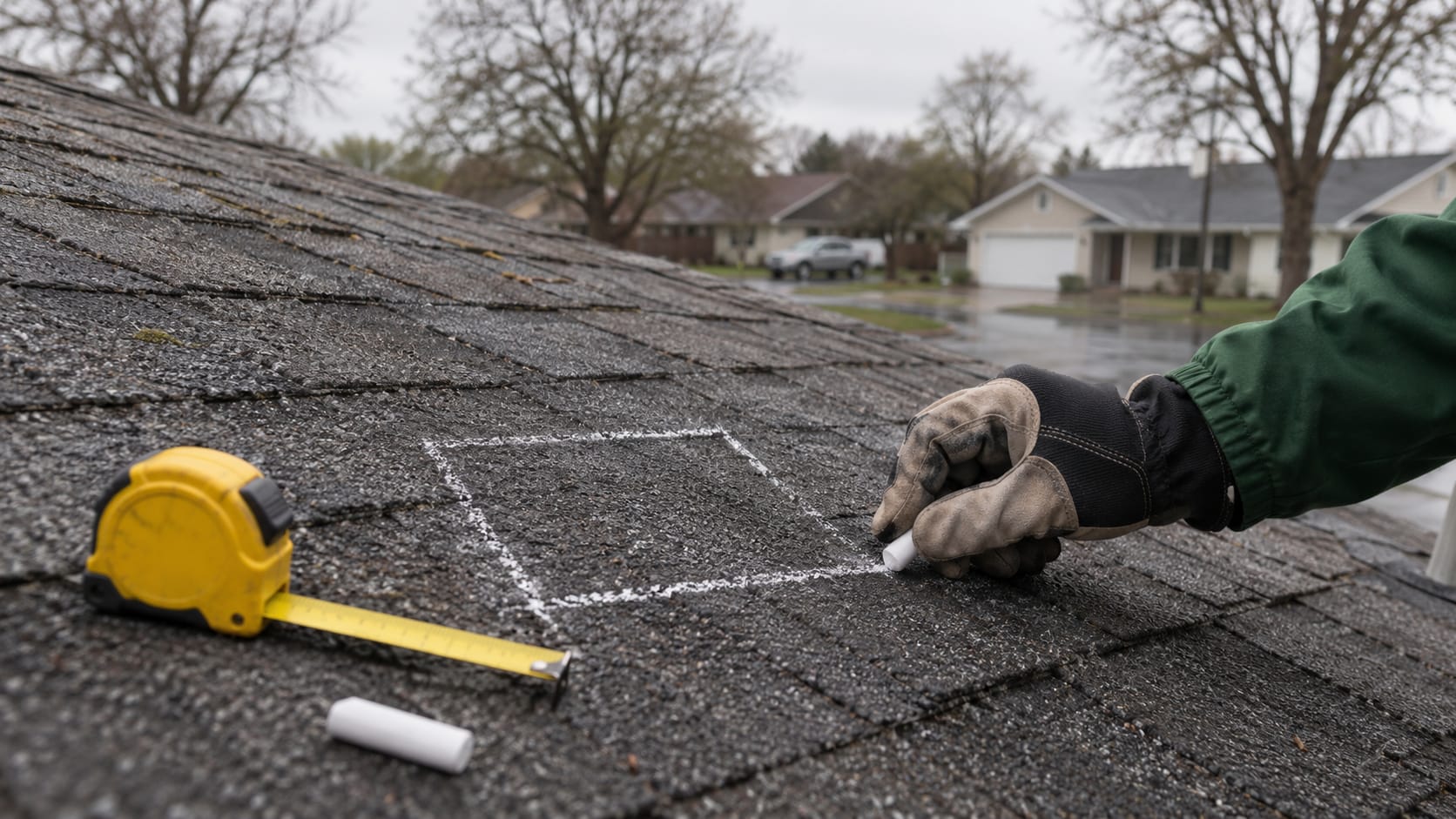
The second check is the one a policyholder is least equipped to answer. Public storm reports are preliminary, and the absence of a report does not show that no hail fell38. A neighbor's memory is not a record. What the insurer checks in a hail claim explains the evidence each side uses.
The path from the storm to a paid claim
- Report the damage promptly. Contact the insurer or agent as soon as possible, with the date of the storm and as much detail about the damage as you have3536.
- Protect the property and keep receipts. Most policies require temporary measures to prevent further damage. Permanent repairs wait until the insurer has inspected3534.
- Read the declarations page. Find the wind and hail deductible, whether the roof is paid at replacement cost or actual cash value, and any cosmetic damage exclusion87.
- Compare the likely repair cost with the deductible. The Nebraska regulator suggests considering not filing when repairs will cost less than the deductible, because some companies count wind and hail occurrences at renewal even when nothing is paid10.
- Document the storm at the address. Photograph the damage, including cars, wood fences, shutters and siding at ground level, which the Nebraska regulator lists as signs of hail strong enough to damage a roof10. Where the insurer doubts the date or the hail, a verification report for the address documents what was recorded there. Skybridge Intelligence sells one: for one place and a window of one to three days it states what weather satellites recorded there, and for US addresses it adds NOAA radar hail size estimates and Storm Prediction Center reports39. Each report carries a verification code that the adjuster or the insurer can check online without an account40. The company describes the report as independent evidence that supports a claim and an adjuster's inspection, and states that it replaces neither and does not guarantee that an insurer accepts a claim39.
- Attend the inspection and get the estimate in writing. Prepare a list of everything that appears damaged, and ask the adjuster to explain any difference from a roofer's estimate10.
- Pay the deductible yourself. In Texas the law requires it, and in Colorado, Oklahoma, Minnesota, Missouri and Iowa a contractor who offers to cover it is breaking the law151722242832.
- If the answer is no, ask for the reason in writing. Then use the routes the policy and the state provide: a conversation with the adjuster's manager, the appraisal clause, a licensed public adjuster or a complaint to the state insurance department4142.
What a good outcome looks like
The claim is reported within days. The insurer acknowledges it inside the period state rules set. The file holds dated photographs, a storm record for the address and a written estimate. The adjuster's inspection and the storm record agree on the date and on the size of the hail. The payment equals the repair cost less a deductible the owner knew about in advance, with the depreciation released when the work is done. Where the two sides disagree, the disagreement is about a number in an estimate and not about whether the storm happened.
Frequently asked questions
Does homeowners insurance cover hail damage to a roof?
Usually, yes. The Oklahoma Insurance Department states that most standard homeowners insurance covers hail damage to the roof and other parts of the home. The same page warns that a policy may exclude cosmetic damage or carry a higher deductible for hail, and regulators note that some policies pay only the depreciated value of the roof. The declarations page and the endorsements say which terms apply.
Does car insurance cover hail damage?
Only with comprehensive coverage. The Insurance Information Institute lists hail among the events comprehensive covers, and the Oklahoma Insurance Department states that a driver with liability coverage alone may not be covered for a hail claim. Comprehensive is optional coverage and is usually sold with its own deductible.
What is a cosmetic hail damage exclusion?
A policy term that removes cover for hail damage that changes how a surface looks without changing how it works. The Oklahoma Insurance Department describes cosmetic damage as damage that affects only the aesthetics rather than the function of the house. Dents in a metal roof that still sheds water are the usual example. Whether a policy has the exclusion is stated in its endorsements.
What is a wind and hail deductible?
A separate deductible that applies only when wind or hail causes the loss. The Insurance Information Institute reports that these deductibles are most commonly a percentage, typically from 1 to 5 percent of the home's insured value, and are most common in the Midwest and in Texas, Oklahoma, Kansas and Nebraska. On a home insured for $250,000, a 2 percent deductible is $5,000.
How long do you have to file a hail damage claim?
The policy sets the period, within limits that differ by state. Texas lets certain insurers require a claim within one year of the date of loss. Oklahoma bars a property policy from limiting a lawsuit to less than one year from the event. Minnesota's standard fire policy allows two years to sue and Iowa's allows twelve months. Regulators in every state we read give the same advice, which is to report the damage as soon as possible. Check your policy and your state's rule.
Will my premium go up after a hail claim?
It depends on the state and the insurer. The Texas Consumer Bill of Rights states that an insurer cannot increase a premium based on claims for damage from natural causes, including weather. The Nebraska Department of Insurance notes that some companies consider wind and hail occurrences when deciding whether to renew, even where nothing was paid, and Indiana's regulator states that insurers may consider claims activity at renewal.
What is the average insurance payout for hail damage to a roof?
No public source isolates roof-only hail claims. The closest published figure is the Insurance Information Institute's, from Verisk data, which puts the average homeowners wind and hail claim at $15,708 for 2020 to 2024. That average combines wind with hail, covers all damaged parts of the home and excludes Texas. An individual payment depends on the deductible and on whether the roof is paid at replacement cost or actual cash value.
What does the insurer check in a hail claim?
Four things. That the policy was in force on the date of loss. That hail of a damaging size fell at the address on that date. That the marks on the roof or the car are hail and not wear, blistering or mechanical damage. And that the repair cost exceeds the deductible. Storm records and the adjuster's inspection settle the second and third.
Sources
- Facts + Statistics: Hail. Insurance Information Institute. Accessed 20 Nov 2026.
- Facts + Statistics: Homeowners and renters insurance. Insurance Information Institute. Accessed 20 Nov 2026.
- Wind and hail. Oklahoma Insurance Department. Accessed 20 Nov 2026.
- State Farm settlement information for Oklahoma homeowners with wind and hail damage claims. Oklahoma Insurance Department. Accessed 20 Nov 2026.
- Home insurance. Georgia Office of the Commissioner of Insurance and Safety Fire. Accessed 20 Nov 2026.
- Raising the roof on insurance coverage. Missouri Department of Insurance. Accessed 20 Nov 2026.
- Residential property: shopping guide. Texas Office of Public Insurance Counsel. Accessed 20 Nov 2026.
- Post-Disaster Claims Guide. Oklahoma Insurance Department. Accessed 20 Nov 2026.
- Understanding your insurance deductibles. Insurance Information Institute. Accessed 20 Nov 2026.
- Hail damage: does my roof need repair?. Nebraska Department of Insurance. Accessed 20 Nov 2026.
- What is covered by a basic auto insurance policy?. Insurance Information Institute. Accessed 20 Nov 2026.
- Auto insurance. Georgia Office of the Commissioner of Insurance and Safety Fire. Accessed 20 Nov 2026.
- Texas Insurance Code, Chapter 2301, Sec. 2301.010: contractual limitations period and claim filing period in certain property insurance forms. Texas Legislature, Texas Constitution and Statutes. Accessed 20 Nov 2026.
- Consumer Bill of Rights: Homeowners, Dwelling, and Renters Insurance (28 TAC §5.9971(b), 2024 version). Texas Department of Insurance, published by the Office of Public Insurance Counsel. Accessed 20 Nov 2026.
- Texas Insurance Code, Chapter 707: payment of insurance deductible. Texas Legislature, Texas Constitution and Statutes. Accessed 20 Nov 2026.
- Colorado Revised Statutes § 10-4-110.8: homeowner’s insurance, prohibited and required practices. Colorado Revised Statutes, text as reproduced by Public.Law. Accessed 20 Nov 2026.
- Colorado Revised Statutes § 6-22-105: waiver of insurance deductible prohibited. Colorado Revised Statutes, text as reproduced by Public.Law. Accessed 20 Nov 2026.
- Senate Bill 26-155, Session Laws of Colorado 2026, Chapter 373: Strengthen Colorado Homes Enterprise. Colorado General Assembly, 4 Jun 2026. Accessed 20 Nov 2026.
- Title 210, Nebraska Administrative Code, Chapter 60: unfair property and casualty claims settlement practices. Nebraska Department of Insurance. Accessed 20 Nov 2026.
- Kansas Statutes Annotated 60-511: actions limited to five years. Kansas Office of Revisor of Statutes. Accessed 20 Nov 2026.
- Oklahoma Statutes, Title 36 (Insurance): §§ 1250.7, 3617 and 4803. Oklahoma State Legislature. Accessed 20 Nov 2026.
- Oklahoma Statutes, Title 59, § 1151.30: offer to pay insurance deductible. Oklahoma State Legislature. Accessed 20 Nov 2026.
- Minnesota Statutes § 65A.01: Minnesota standard fire insurance policy. Minnesota Office of the Revisor of Statutes. Accessed 20 Nov 2026.
- Minnesota Statutes § 325E.66: insurance claims for residential contracting goods and services. Minnesota Office of the Revisor of Statutes. Accessed 20 Nov 2026.
- South Dakota Codified Laws 15-2-13: actions that must be commenced within six years. South Dakota Legislature. Accessed 20 Nov 2026.
- South Dakota Codified Laws 53-9-6: restraints on legal proceedings void. South Dakota Legislature. Accessed 20 Nov 2026.
- South Dakota Codified Laws 58-33-67: unfair or deceptive practices in dealing with insured. South Dakota Legislature. Accessed 20 Nov 2026.
- Revised Statutes of Missouri § 407.725: work and services for insured persons, contractors not to induce sales. Missouri Revisor of Statutes. Accessed 20 Nov 2026.
- Total loss auto claims with your insurance company. Illinois Department of Insurance. Accessed 20 Nov 2026.
- Filing a claim with your own insurance company. Illinois Department of Insurance. Accessed 20 Nov 2026.
- Iowa Code 2026, § 515.109: fire insurance contract, standard policy provisions. Iowa Legislature. Accessed 20 Nov 2026.
- Iowa Code 2026, § 103A.71: residential contractors. Iowa Legislature. Accessed 20 Nov 2026.
- Insurance claim tips. Indiana Department of Insurance. Accessed 20 Nov 2026.
- Insurance claim tips. Georgia Office of the Commissioner of Insurance and Safety Fire. Accessed 20 Nov 2026.
- Director of Insurance offers tips for individuals affected by weather-related damages. Nebraska Department of Insurance. Accessed 20 Nov 2026.
- When disaster strikes: what to do after an insured homeowner’s loss occurs. South Dakota Division of Insurance. Accessed 20 Nov 2026.
- Severe weather definitions. National Weather Service, Binghamton, NY. Accessed 20 Nov 2026.
- A complete sample report: hail and lightning, Kankakee, IL, 10 March 2026. Skybridge Intelligence. Accessed 20 Nov 2026.
- Skybridge Intelligence: llms.txt (what a report is, data sources, prices, framing). Skybridge Intelligence. Accessed 20 Nov 2026.
- Verify a report. Skybridge Intelligence. Accessed 20 Nov 2026.
- Residential property claims. Texas Office of Public Insurance Counsel. Accessed 20 Nov 2026.
- Ways to resolve your claim payment disputes. Texas Office of Public Insurance Counsel. Accessed 20 Nov 2026.
Updated 20 Nov 2026: First published, with twelve states in the table.